Natural color failures are rarely ingredient failures.
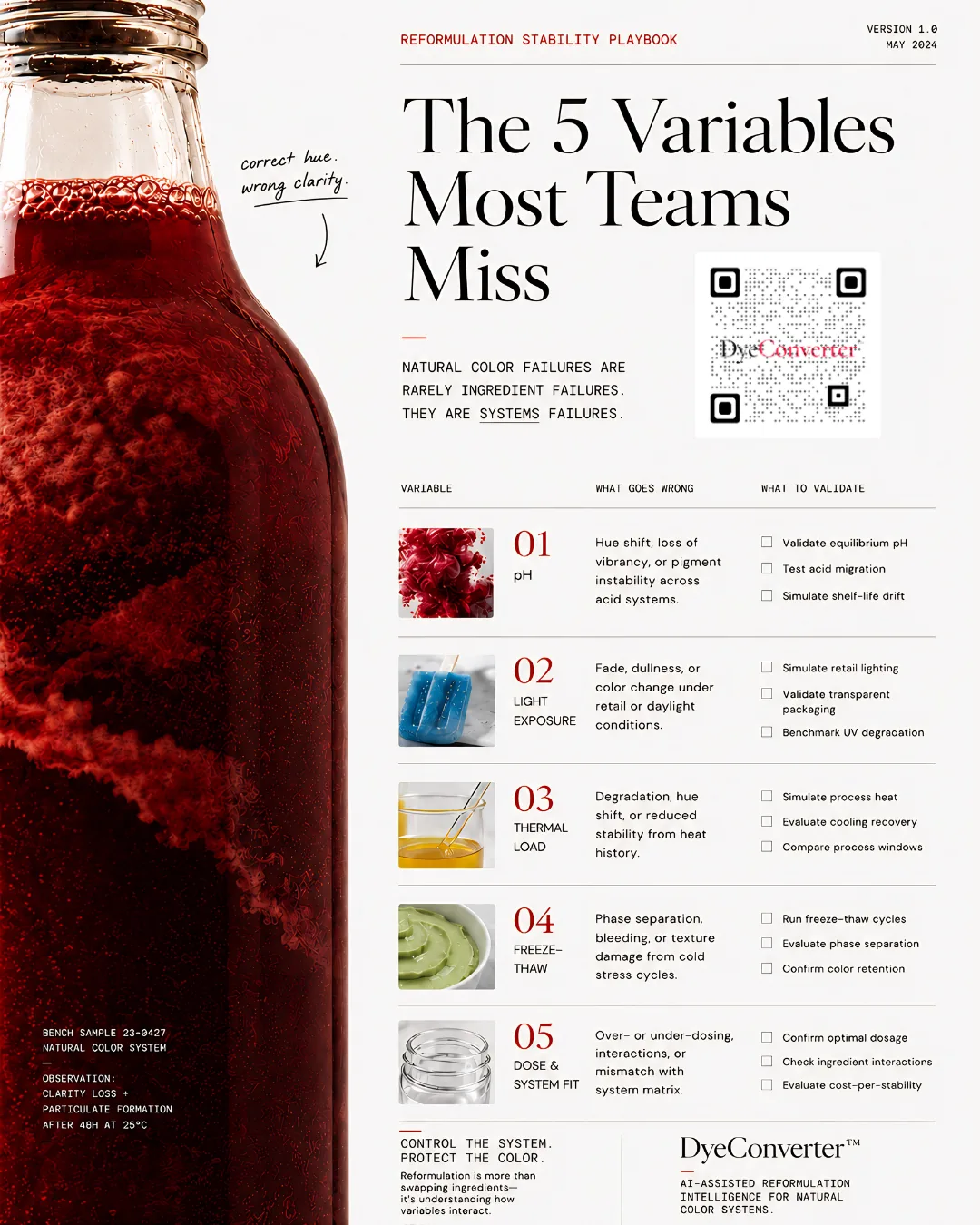
Natural color failures are rarely ingredient failures. They are systems failures.
A pigment that looked perfect on the bench drifts on the line. The team blames the dye. The dye was never the problem. The pH moved. Retail lighting cooked it. Heat history shifted the hue. A freeze-thaw cycle broke it. The dose was wrong for the system. By scale-up, a 27-out-of-100 stability score is an expensive surprise instead of an early flag.
Five variables decide whether a natural color survives the jump from bench to shelf, and most teams catch them too late.
pH drift. Color shifts as the system equilibrates, not when you mix it. Validate the final equilibrium pH, not the mixing-bowl number.
Light exposure. Retail lighting destroys what the bench approved. Validate against simulated retail light and the real packaging.
Thermal stability. Heat history changes hue, vibrancy, and fade rate. Validate cooling recovery, not just peak temperature.
Freeze-thaw. Cold is one of the hardest stress tests color faces. Run the cycles and confirm the system does not separate.
Dose and system fit. More pigment is not more stability. Often it is less. Confirm the optimal dose and the cost per stable unit, not the maximum load.
None of these show up in a quick bench check. All of them show up at scale, when changing course is slowest and most expensive.
DyeConverter™ models all five before the batch, so drift becomes a prediction instead of a postmortem.
Do not just confirm the color. Protect it.
#NaturalColorants #DyeConverter #FDA2027