Blue in the bottle. Red in the glass.
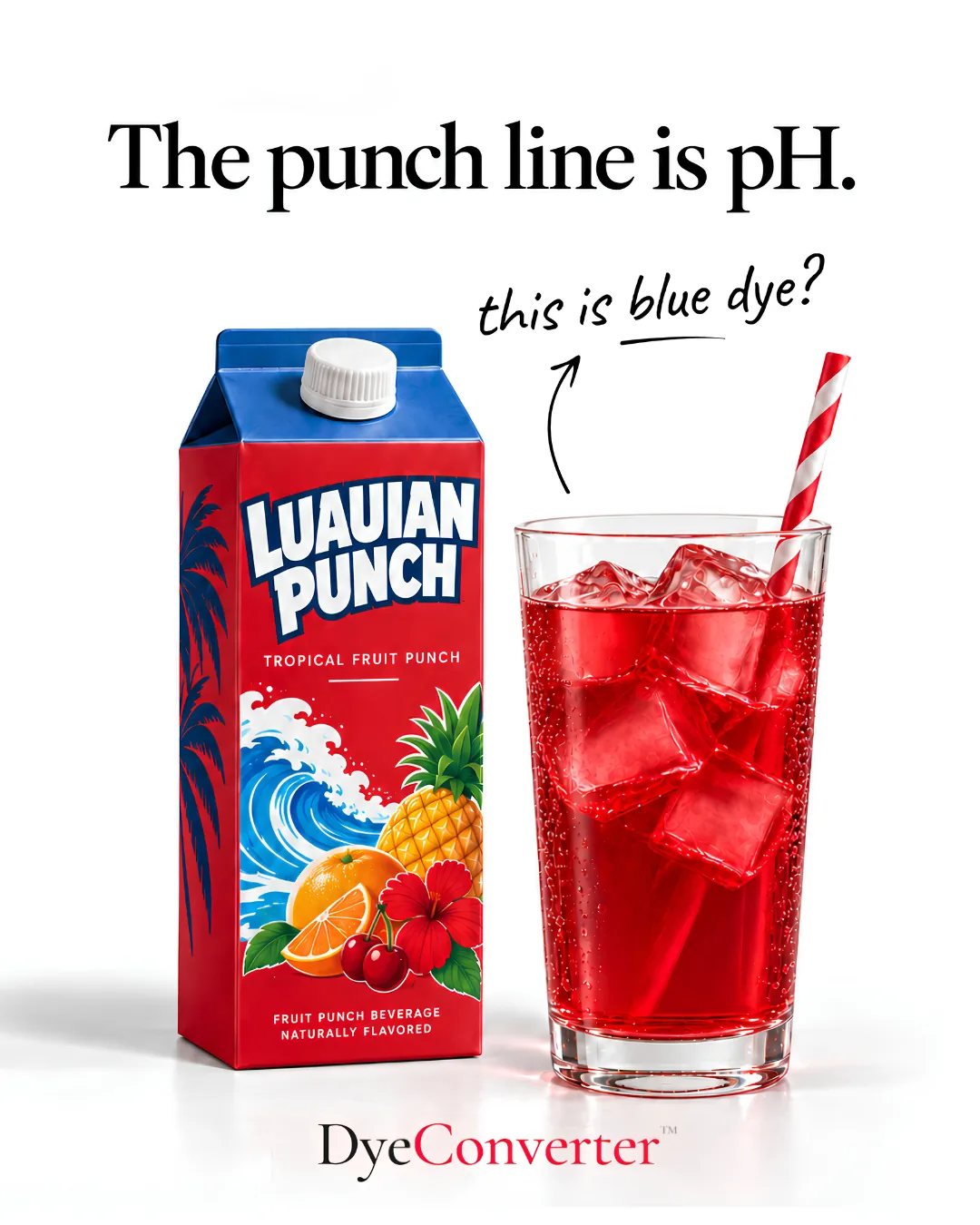
Blue in the bottle. Red in the glass. Same dye.
Butterfly pea flower extract is the color that makes lattes blue. Drop it into tropical punch and it doesn't stay blue; it doesn't want to. The pigment is a family of ternatins, delphinidin anthocyanins carrying several p-coumaroyl acyl groups. Those acyl groups fold over the color core and shield it, which is why butterfly pea survives conditions that wreck ordinary berry anthocyanins.
What they can't shield is pH. Anthocyanins change molecular shape with acidity. Near neutral, the pigment sits as a quinoidal base and reads blue. Around pH 4 it slides through purple. At punch pH, roughly 3, it converts to the flavylium cation and snaps to magenta. Nobody added red. The acid rewrote the molecule.
That's the punch line. The pH picked the color, not the flower.
Getting from magenta to a true punch red takes one more move. A little red anthocyanin, black carrot or red radish, walks it the last step. Then the whole system has to hold, and this is where the real work lives.
Heat: ternatins are more heat-stable at their blue pH than at their magenta pH, so a hot-fill on an acidic punch costs more color than the same fill on a neutral drink. Cold-fill with preservatives is the friendlier route.
Light: clear packaging fades anthocyanins on the shelf. An opaque carton is a formulation decision, not a marketing one.
Vitamin C: ascorbic acid and anthocyanins degrade each other, so the bigger the immunity claim on the label, the faster the color dies. Dose it with the color in mind.
Metals: delphinidin's B-ring chelates iron and aluminum. Trace metal from water or equipment will drag the shade toward blue-gray and can drop dark complexes.
Copigments: flat molecules like catechins and caffeine stack on the flavylium ring and block the water that bleaches it. In butterfly pea extract, catechin at high ratios nearly doubled pigment half-life under heat.
Regulatory: FDA listed butterfly pea flower extract in 2021 for fruit drinks, carbonated soft drinks, sports and energy drinks, flavored water and teas, then widened it in 2025 to cereals, crackers and chips. No E-number in the EU, so this is a US concept for now.
The color is legal. The chemistry is the work.
That work is what DyeConverter™ does before the first bench trial: finished pH, acid system, vitamin C load, fill temperature, metal exposure, all modeled against real dyes from real suppliers. The swap is never one ingredient. It's the whole recipe.
#FutureOfFood #DyeConverter #NaturalColor