BenchTest #005 -- How do I know my paprika will stay fiery red in my corn chips for 12 months?
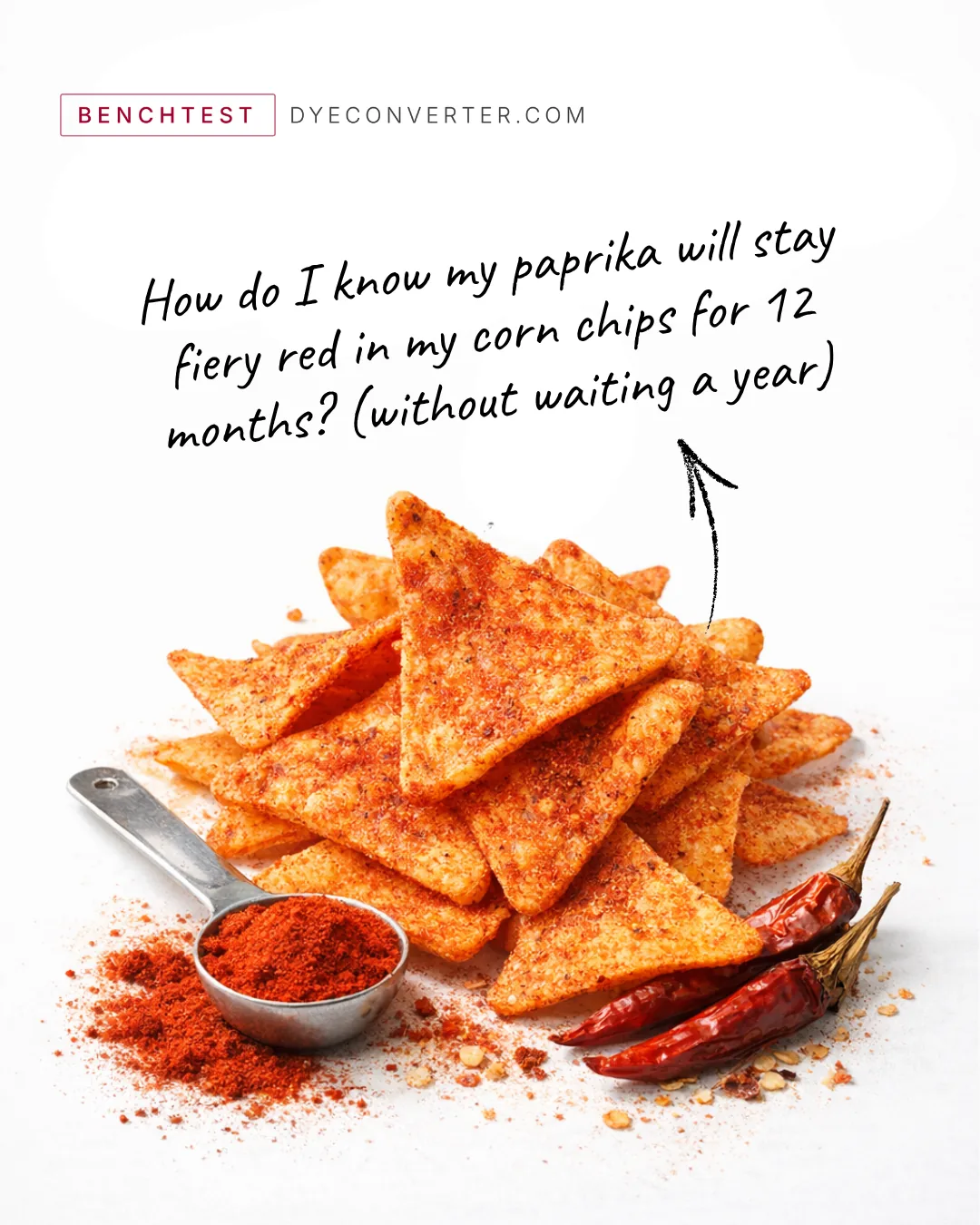
BenchTest #005 -- How do I know my paprika will stay fiery red in my corn chips for 12 months? (without waiting a year)
Short answer: you cheat. Scientifically.
It's called accelerated stability testing -- and it's one of the most underused tools in natural color reformulation. Instead of sitting around for 12 months hoping your paprika doesn't bail on you, you store your samples at elevated temperatures (around 32C / 90F) for 2 to 3 months. The heat fast-forwards degradation, giving you a reliable preview of how that pigment will hold up on a real shelf, in a real store, under real fluorescent lighting.
Think of it like a time machine for your color. Minus the DeLorean.
Here's what most R&D teams get wrong: they test in ideal conditions. Controlled humidity. Perfect darkness. Lab-grade packaging. That's not a Walmart shelf. Real-world testing means replicating the chaos -- temperature swings during shipping, light exposure in the store, oxygen ingress through packaging. Your paprika might look gorgeous in the lab and ghost you in the warehouse.
The fix? Run your accelerated tests across multiple conditions. Light vs. dark. Ambient vs. stressed heat. Open vs. sealed. Three months of data at 32C will tell you more than a year of wishful thinking at room temp.
And if the paprika doesn't make it? That's not a failure. That's intelligence. Now you know to explore a more heat-stable carotenoid or consider encapsulation before your product hits the line -- not after 50,000 units are already on trucks.
The mandate isn't waiting. Neither should your stability data.
#FutureOfFood #DyeConverter #BenchTest