Why does beet color speckle strawberry milk instead of turning it pink?
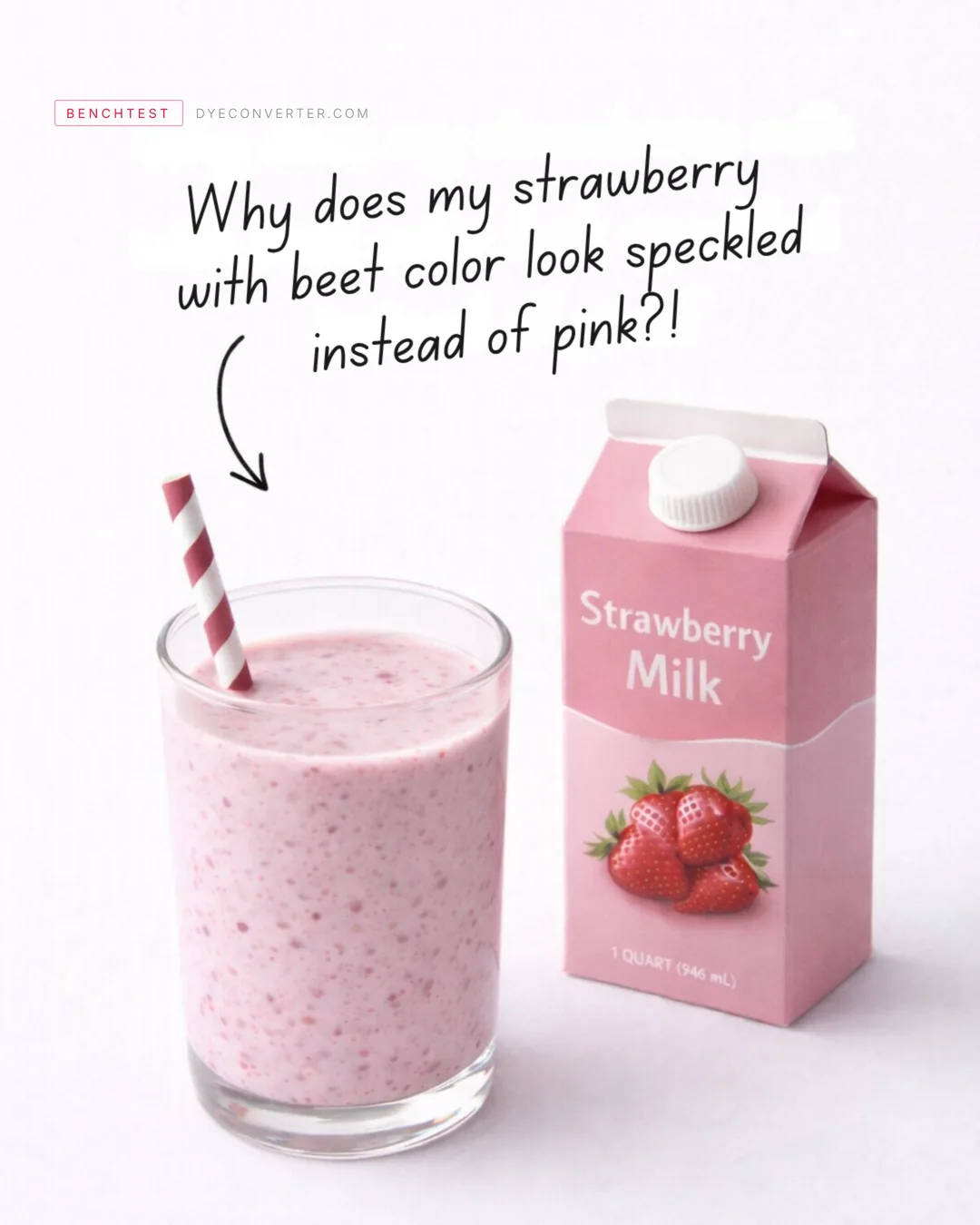
Why does beet color speckle strawberry milk instead of turning it pink?
Short answer: betanin does not dissolve in fat. And milk is full of it.
Beet color gets its red from betanin, a water-soluble pigment. When you drop it into milk, the pigment dissolves into the water phase but cannot penetrate the fat globules. Those tiny fat droplets scatter light on their own, and the betanin clusters around them unevenly. The result is visible speckling instead of a smooth, uniform pink.
Homogenization helps. Smaller fat globules mean more even pigment distribution. But even in highly homogenized milk, betanin can aggregate with casein proteins at certain pH ranges, creating micro-clumps that show up as darker pink spots.
The real fix is particle size and dispersion method. Pre-dissolving the beet concentrate in warm water before blending into the dairy base gives the pigment time to fully hydrate and disperse before it hits the fat matrix. Some formulators also add a small amount of emulsifier to bridge the water-soluble pigment into a more uniform suspension.
Temperature matters too. Betanin degrades above 50C and is most stable between pH 4 and 5. Milk sits around pH 6.7. That higher pH accelerates breakdown over shelf life, which is why beet-colored dairy products can shift from pink to brown faster than expected.
This is one of dozens of dairy-specific formulation challenges mapped inside DyeConverter™. The platform matches natural color alternatives to your specific matrix, process conditions, and stability window so you stop troubleshooting by trial and error.
#DyeConverter #CleanColor #FutureofFood