Two M&M colors didn't survive the switch to natural.
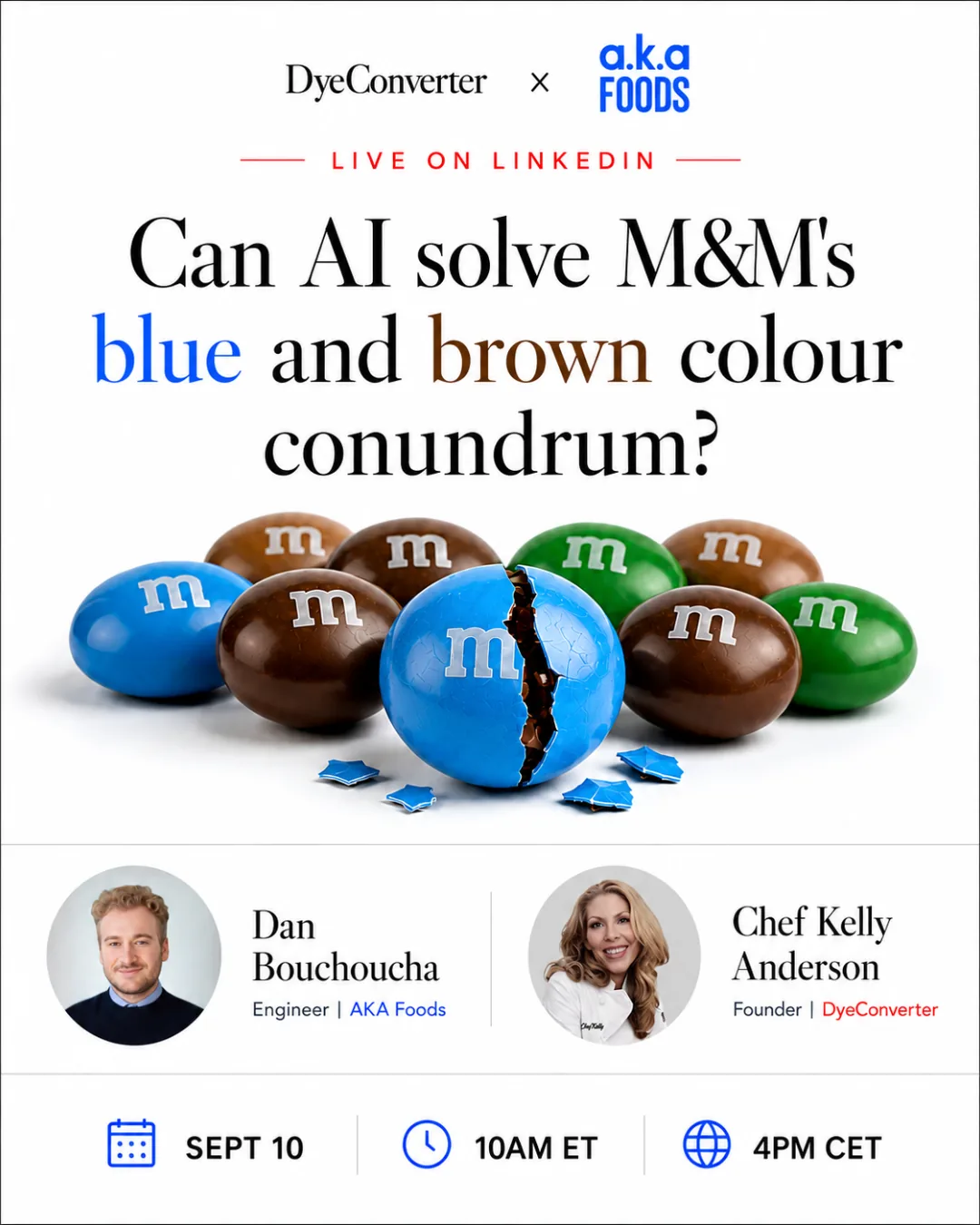
Two M&M colors didn't survive the switch to natural. That's not a tragedy. It's a great demo.
When Mars rolled out dye-free M&Ms this summer, blue and brown didn't make the bag. The natural blue they reached for, spirulina, needs about seven times the volume of the synthetic it replaces, drives up cost, and clogs the factory spray nozzles at scale.
Here's the part most people miss: that factory headache isn't really a factory problem. It's a formulation decision made way upstream. Pick a different colorant, and the whole downstream picture, cost, use rate, equipment, changes with it.
On September 10, Dan Bouchoucha (Sales Engineer, AKA Foods) and I are going live on LinkedIn to show exactly how AI can help a food scientist work a problem like this: exploring candidate natural colorants, comparing use rates and cost, and turning a shortlist into production-ready formulations on AKA Studio, with the M&M palette as our tangible example.
You'll see: - How AI matches a natural colorant to a specific synthetic dye, for shade, thermal survival, and substrate compatibility - Why the colorant you choose sets your cost, use rate, and equipment constraints downstream - How to evaluate alternatives fast when your first pick doesn't survive the process
Built for food scientists, R&D managers, and product teams working on clean-label reformulation, especially in confectionery and coated products.
To be clear: this is a demonstration, not a claim that we've solved Mars' color problem. Mars is doing that work themselves. The M&M question is just a real, well-known example that makes the method tangible.
September 10 | 10 AM ET / 4 PM CET | 60 minutes, live and recorded, with live Q&A throughout.
Save your seat at the link in the comments. Bring your hardest color.