De-risking blue is a different sport.
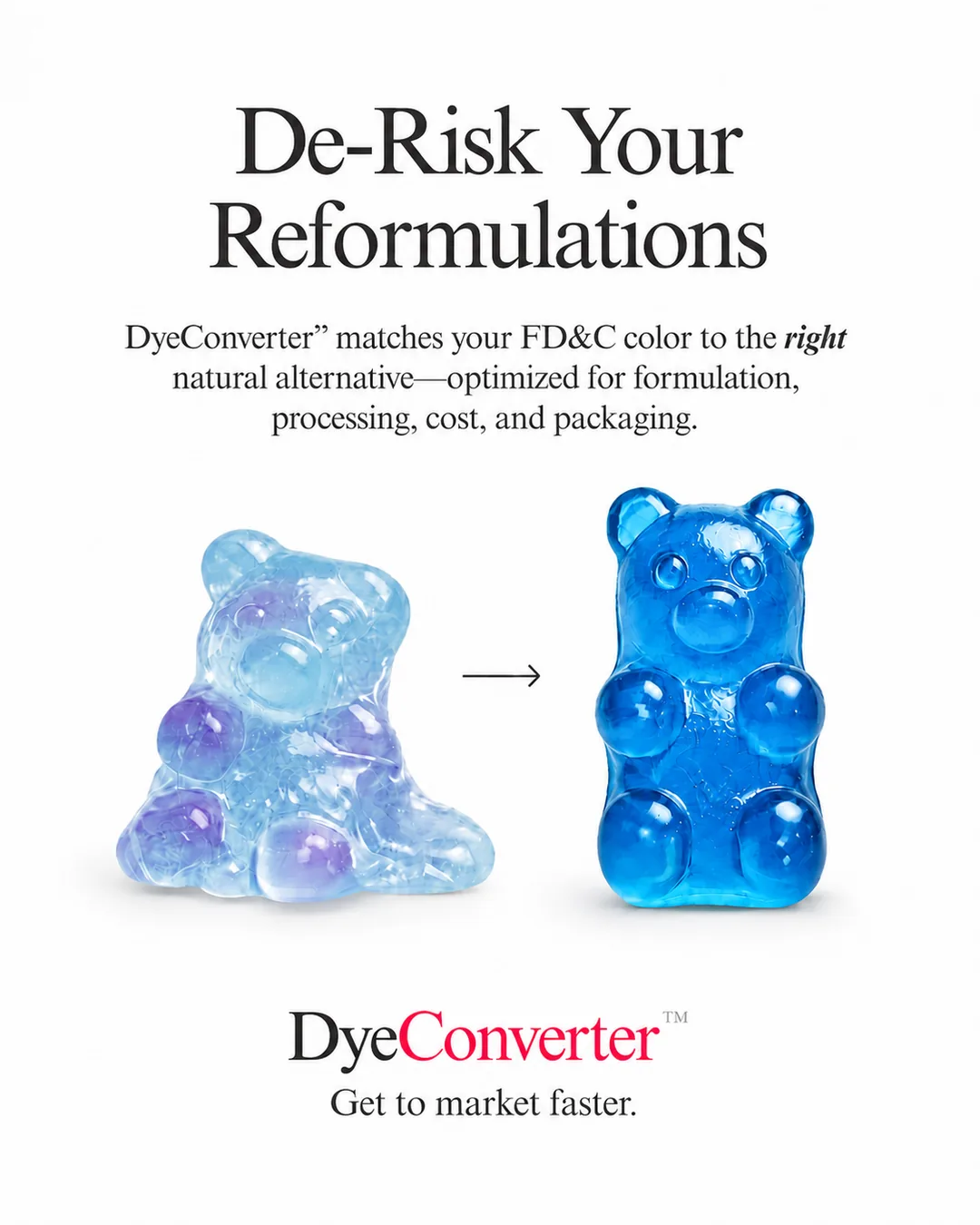
De-risking blue is a different sport.
Most natural color swaps are about finding any pigment that survives the matrix. With blue, the problem starts one step earlier: the practical natural palette barely qualifies as a list. The one most teams reach for first is butterfly pea flower, and it is also where most teams get burned.
Butterfly pea looks like the answer. Real natural blue, plant-based, label-friendly. The catch is the chemistry. Its color comes from an anthocyanin, which means it is a pH chameleon. Blue between roughly pH 5 and 7. Purple between 3 and 4. Pink or red below that.
Now drop it into a sour gummy. Gummy formulas live at pH 3 to 3.5. Add the cooking heat at 200°F and up, and the pigment degrades further on the way down. The result is exactly what shows up on the left side of the card: a mottled blue with purple splotches, and a color that keeps drifting as the matrix equilibrates over shelf life.
The shade is not the problem. The match is.
DyeConverter™ matches an FD&C color to the right natural alternative for the actual formulation, processing, cost, and packaging on the line. For a sour gummy, that probably is not butterfly pea straight in. It might be encapsulated, buffered, dosed differently, or a different pigment system entirely.
The chemistry has not gotten more forgiving. The decision model has.
Get to market faster.
#NaturalColorants #DyeConverter #FDA2027